
The C.E.H. Project and BETA 21
In 1962, Rolex joined 20 other Swiss brands in the Centre Electronique Horologer (C.E.H.) with the goal of developing an electronic movement for wristwatches. The movement's components were manufactured by Ebauches SA, culminating in the creation of the BETA 21. This innovative movement, superior in performance for its time, boasted a rate error of less than one minute per year, a true revolution in watch precision.
Similar in technology to the Bulova Accutron, the BETA 21 is distinguished by its continuous second hand movement, free of the typical "jumps" of common quartz watches, thus imitating the fluid motion of mechanical mechanisms. This pioneering achievement was presented to the public in the summer of 1970 in Geneva, where Rolex inaugurated the famous "Roll of Honour" and the Oyster-Quartz Club. (ph: bobswatches.com)
Similar in technology to the Bulova Accutron, the BETA 21 is distinguished by its continuous second hand movement, free of the typical "jumps" of common quartz watches, thus imitating the fluid motion of mechanical mechanisms. This pioneering achievement was presented to the public in the summer of 1970 in Geneva, where Rolex inaugurated the famous "Roll of Honour" and the Oyster-Quartz Club.
The Oyster-Quartz: A Unique Collection
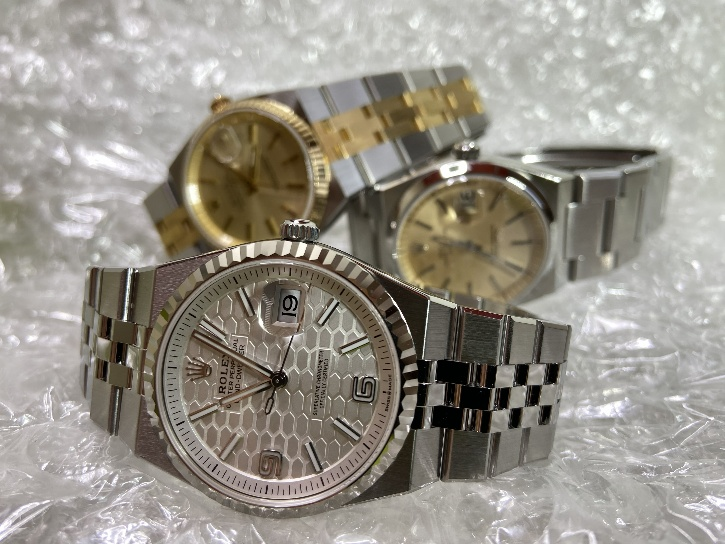
The Rolex Oyster-Quartz represents a very special collection within the Rolex family. Introduced in 1976, the quartz movement of the OysterQuartz required five years of development. Despite its distinctive design and atypical of other Rolex models, the OysterQuartz made a name for itself with its revolutionary precision, raising hopes for a future dominated by quartz. Available exclusively in the Datejust and Day-Date versions, in white and yellow gold, the Oyster Quartz remained in production for 25 years. During this period, only 25,000 pieces were made, making it a rare and coveted watch. In the 1970s and 1980s, quartz watches were the new thing, so much so that prestigious brands like Audemars Piguet had 97% quartz-dominated production.
(ph: bobswatches.com)
The Decline and End of Production
Despite initial optimism, production of the Oyster-Quartz was discontinued in 2001, and the model remained in Rolex catalogs until 2003. Although believed that quartz watches were the future, the return of mechanical movements marked the end of this era. Today, the Oyster-Quartz is a rare collector's item, a symbol of the evolution and innovation that marked a crucial stage in Rolex's history.
Rolex Land-Dweller: Family DNA
16 Sep 2026


Rolex Daytona 126502: The Ghost of Geneva
22 Jul 2026

Watches & Wonders 2026: Rolex Surprises Everyone
11 May 2026
Hai domande?
Chiedi a uno dei nostri esperti certificati una consulenza personalizzata.
Chiedi all'EspertoContinua a leggere


