In the vast ocean of fine watchmaking, there are timepieces designed to caress time, and then there is the Rolex Deepsea Challenge reference 126067: a majestic cathedral of engineering that does more than simply measure time, it defies the laws of physics. Beyond its planetary records, this timepiece represents a truly unique and poignant achievement, embodying the purest, most visceral, and profound essence of the Geneva-based brand's DNA: an all-encompassing obsession with waterproofness. Since the first, pioneering Oyster model in 1926, Rolex's history has been driven by the unforgivable and poetic quest for perfect watertightness, a relentless pursuit of the elements. The Deepsea Challenge is the culmination of this century-long journey, the definitive manifesto of a philosophy of uncompromising love for the extreme. A sacred object of desire, a technological Grail destined to remain a unique and immortal milestone, capable of forever redefining the boundaries of professional watchmaking, to embrace eternity.

No one was truly prepared for such a shock; yet, with the mastery of those who know how to make hearts beat in unison, Rolex shattered the silence of time, leaving the entire world breathless. On November 1, 2022, this guardian of the deep emerged from the darkest and most mysterious depths of the ocean to become a tangible reality. It is no longer an experimental prototype, but the most daring and radical departure ever from the Geneva-based watchmaker, finally accessible to collectors. For the first time in its history, the brand has abandoned steel, embracing the lightness and strength of RLX Titanium.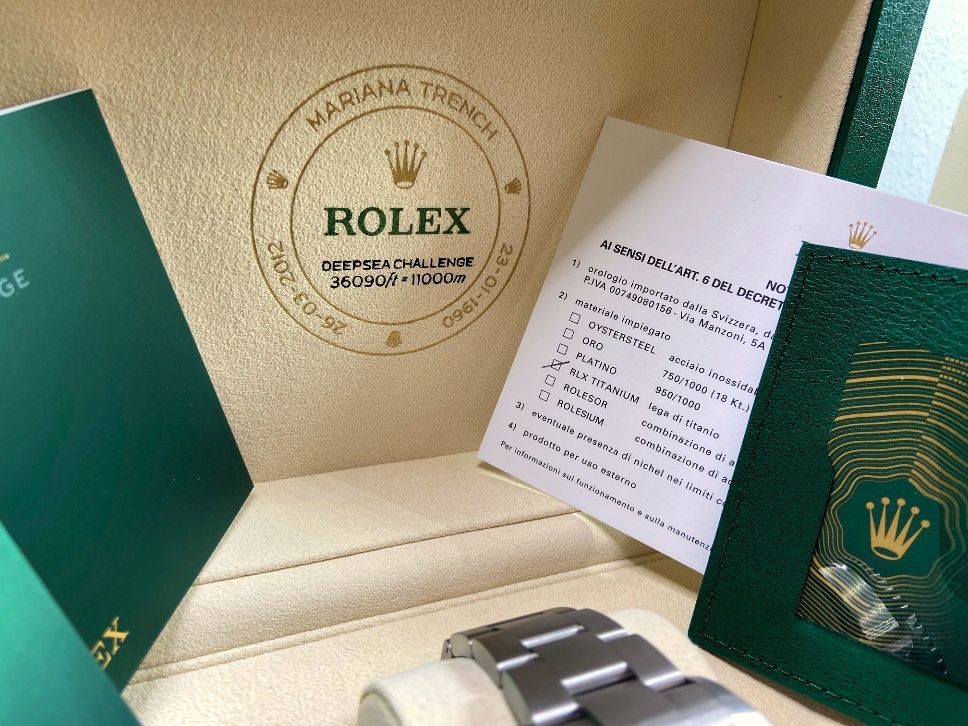
A necessary choice to accommodate the wrist of a mammoth and sensual case, proudly 50 mm in diameter and 23 mm in height; had it been forged from traditional materials, its weight would have been an unbearable burden. Today, however, it sits on the skin like a light and unstoppable armor. Nicknamed the "King of the Deep," the Rolex Deepsea Challenge 126067 boasts a record water resistance of 11,000 meters, where pressure ceases to be an enemy and becomes a faithful ally. A crown and screw-down caseback protect its beating heart from the crushing kiss of the ocean depths, finally giving us mere mortals a technological dream that, for decades, remained jealously guarded in the deepest darkness of the sea.
Rolex's challenge to the depths has its roots in the 1950s, a golden age of great exploration. It all began in 1953, with the first Deep Sea Special prototype, featuring a plexiglass crystal so thick and curved it resembled a submarine porthole. The true date with history, however, came on January 23, 1960, during Project Nekton, where the bathyscaphe Trieste, piloted by Jacques Piccard and Don Walsh, sank to 10,916 meters in the Mariana Trench. Despite a partial shattering of a cabin porthole at 9,000 meters, the pilots courageously continued the descent. The Deep Sea Special was anchored outside the hull, exposed to a deadly pressure of over one ton per square centimeter. The watch survived the feat without a scratch and maintained pinpoint accuracy. Upon returning to the surface, Piccard sent a historic telegram to Geneva: "Happy to confirm that your watch is as accurate to eleven thousand meters as it is on the surface." Today, that legendary timepiece is on display at the Smithsonian Institution in Washington.
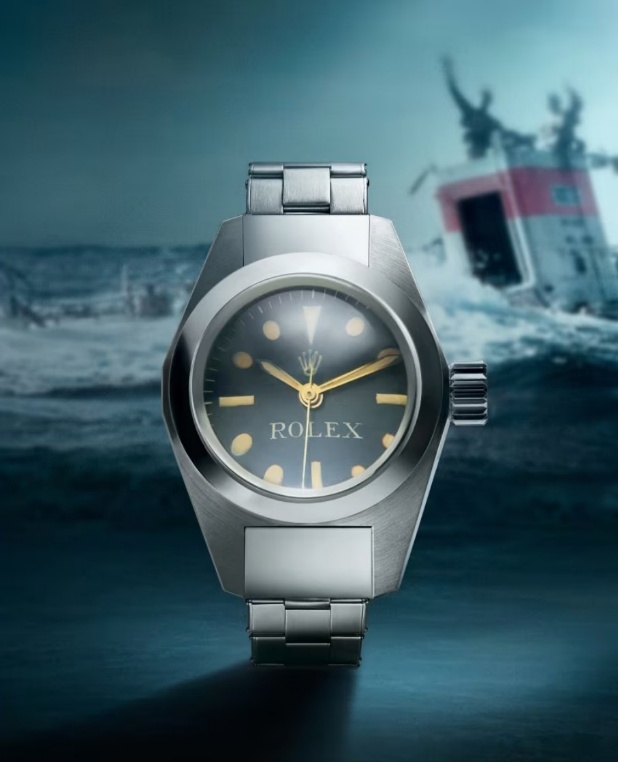
Credit of: rolexmagazine.com
Fifty-two years later, on March 26, 2012, this extraordinary epic was reimagined by filmmaker and pioneer James Cameron. For his historic solo dive into the Challenger Deep, Rolex took on the challenge of designing and building a completely new experimental watch in just eight weeks: the Rolex DEEPSEA CHALLENGE, featuring a thickness of 28.5 mm and guaranteed water resistance to 12,000 meters.

Credit of: rolexmagazine.com
The descent took place aboard the vertical submarine DEEPSEA CHALLENGER, a revolutionary vessel capable of traveling nearly twice as fast as the old Trieste. While the Trieste was a slow, 150-ton horizontal behemoth in 1960, James Cameron's submarine revolutionized the design with a vertical torpedo weighing just 11 tons. The old bathyscaphe took five hours to descend into the Mariana Trench, remaining almost immobile afterward. In contrast, Cameron's vessel halved the time, reaching the bottom in two and a half hours. Furthermore, while the Trieste's crew could only observe through a fixed porthole, Cameron actively piloted the vessel through the depths, thanks to agile engines and high-definition 3D cameras.

Credit of: rolexmagazine.com
Cameron spent approximately three hours on the seabed, at a depth of 10,908 meters, collecting scientific data, constantly monitored by the support yacht Octopus. During the mission, the new Rolex DEEPSEA CHALLENGE timepiece remained attached to the submarine's robotic arm, unscathed by a colossal static load of approximately 12 tons on its sapphire crystal. Alongside this modern technology, the original 1960 Deep Sea Special, worn by the director as a cherished amulet and supreme historical tribute, also traveled inside the cockpit. Both watches weathered the ocean's grip with pinpoint precision and without a scratch.

Credit of: rolexmagazine.com
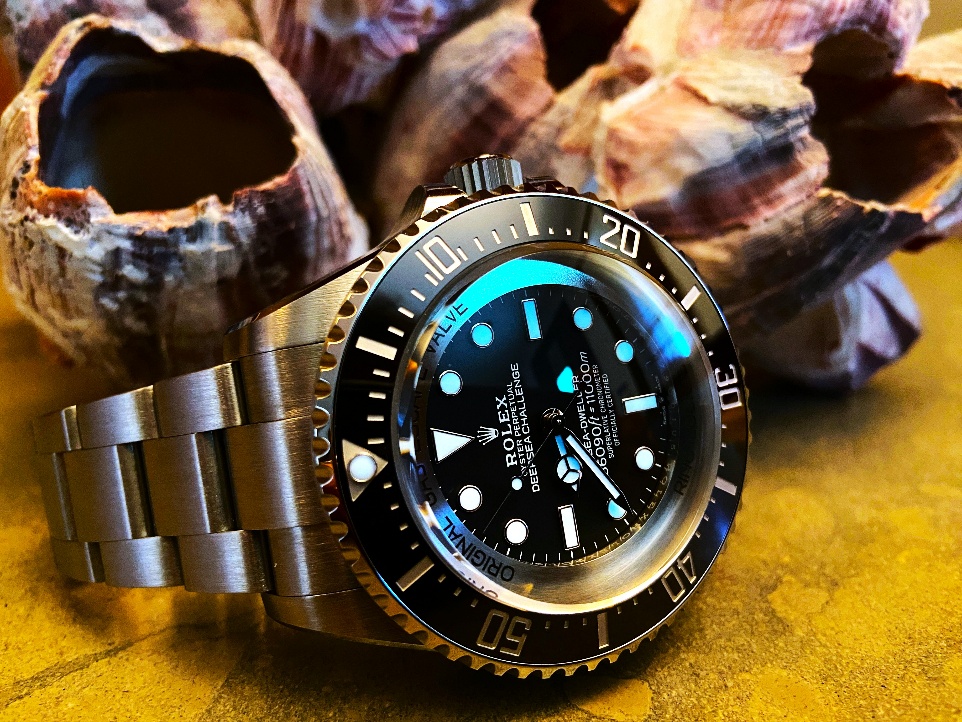
From an engineering perspective, the transition from the steel prototype of the DEEPSEA CHALLENGE, 51.4 mm in diameter and 28.5 mm thick, to the Deepsea Challenge ref. 126067, in 50 mm RLX titanium and 23 mm thick, represented a monumental challenge for Rolex. The secret of this evolution lies in the case, a true dynamic shield based on the patented Rolex Ringlock system, supported by a helium escape valve. Unlike traditional watches, in which hydrostatic pressure threatens to collapse the structure, this model harnesses the buoyancy of the ocean to seal itself. An internal ring of nitrogen-enriched steel absorbs the pressure from the massive domed sapphire crystal and transmits it directly to the titanium caseback. The deeper the watch descends, the more the components compress, making the structure virtually indestructible. Crowning the design, the unidirectional rotating bezel houses a scratch-resistant black ceramic Cerachrom insert, with an engraved 60-minute graduated scale and PVD-coated platinum.
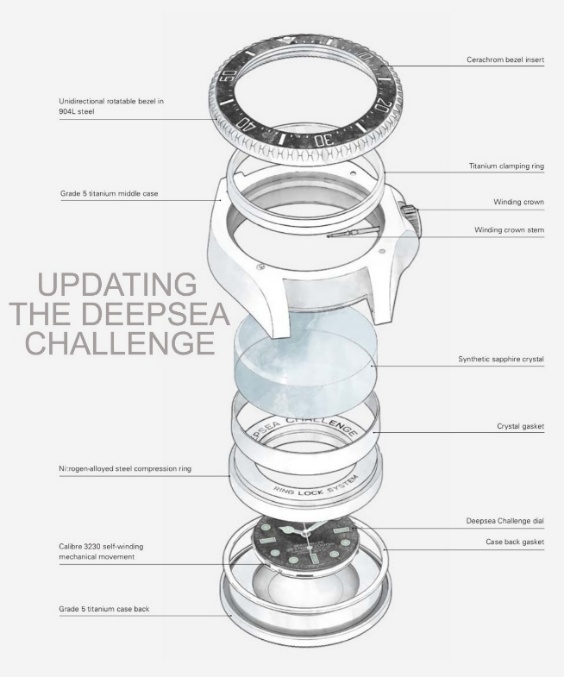
Credit of: rolexmagazine.com
Despite its monumental proportions, the Deepsea Challenge ref. 126067 surprises with its extraordinary and unexpected wearability, belying appearances, thanks to the physical properties of RLX titanium, which reduces the weight by 30% compared to steel. To ensure maximum comfort in every situation, the brushed three-link Oyster bracelet is equipped with an Oysterlock folding safety clasp, integrated with the sophisticated Rolex Glidelock extension system, adjustable up to 20 mm in 2 mm increments, and the Fliplock extension link, which adds an additional 26 mm. Today's commercial model inherits the elegantly polished lugs, an aesthetic nod to legendary vintage Rolexes, blending the avant-garde of titanium with the classic forms of the past. It all culminates in the absolute gem of the screw-down case back, where Rolex reminds everyone of its global successes with the official engraving "Mariana Trench" and the historic dates "23-01-1960" and "26-03-2012", which commemorate the two legendary dives.
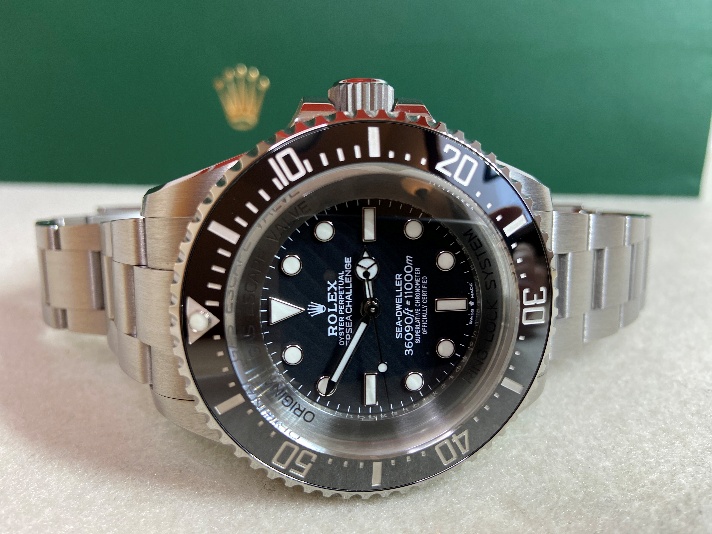
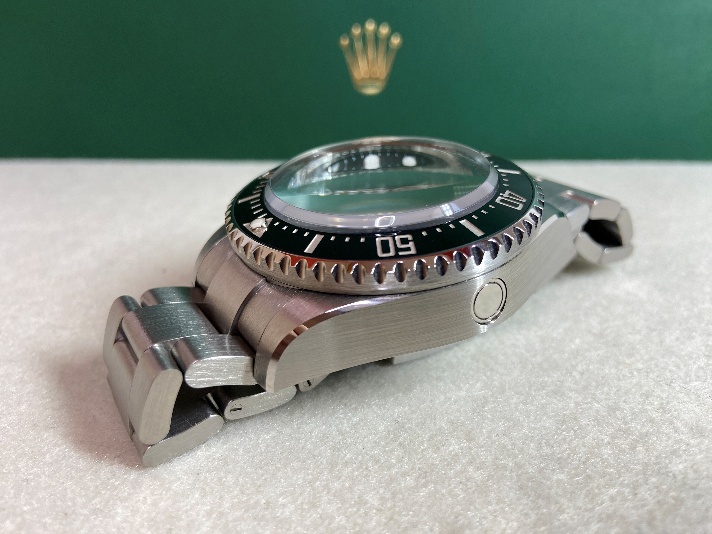
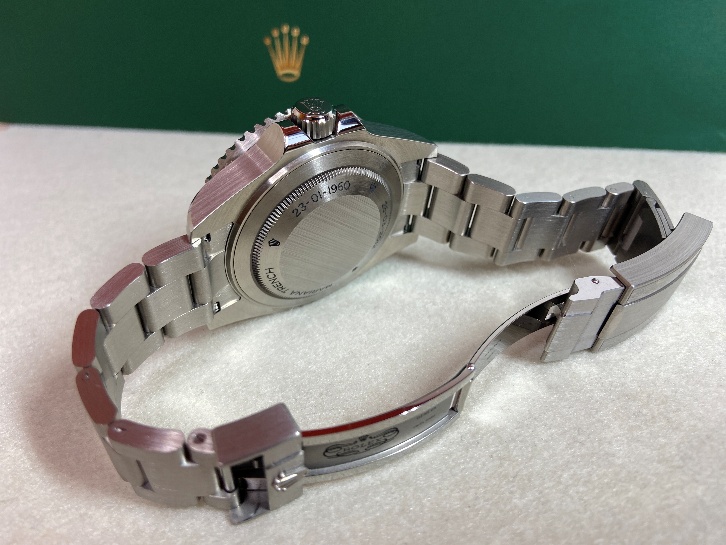
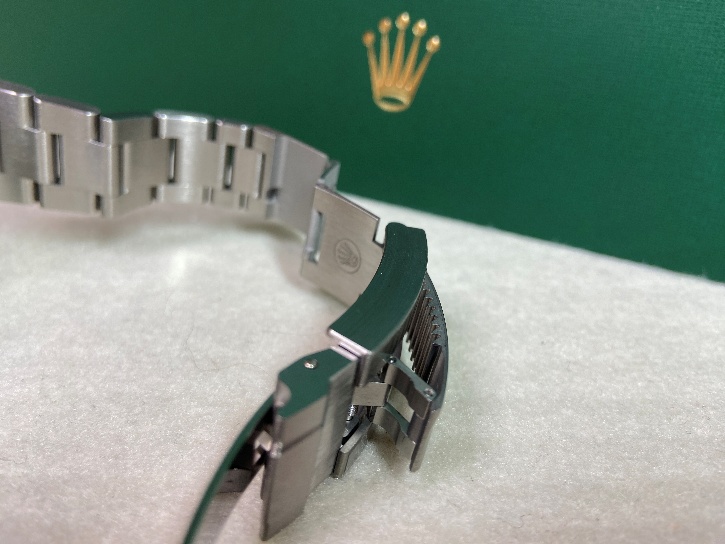
For true watch connoisseurs, the name COMEX evokes a legendary era, one when the famous Compagnie Maritime d'Expertises logo appeared on the dials of rare Rolex Submariners and Sea-Dwellers, such as the historic references 5514 and 16600. Those watches, never intended for retail display but assigned exclusively to elite divers, have become the Holy Grail of collectors, forged directly in the deep. Today, the Rolex Deepsea Challenge carries on that genetic legacy. Although the word "COMEX" isn't printed on the deep black dial, the soul of this titanium RLX timepiece is intimately linked to that glorious past.
Each piece undergoes brutal hyperbaric tests, far beyond standard industrial procedures, inside special ultra-high-pressure tanks developed in exclusive partnership with COMEX. The watch is tested at a whopping 1,500 bar, equivalent to 13,750 meters below sea level, offering a 25% safety margin over the maximum declared depth. Just like the legendary models assigned to divers in the 1970s and 1980s, the Deepsea Challenge is not a simple exercise in style, but a hyper-technical instrument, validated by pioneers of the ocean depths. Wearing it today means wearing the same cutting-edge technical philosophy of the last century on your wrist—a truly "modern COMEX," designed to withstand conditions where conventional technology would be instantly obliterated by the colossal thrust of the water.
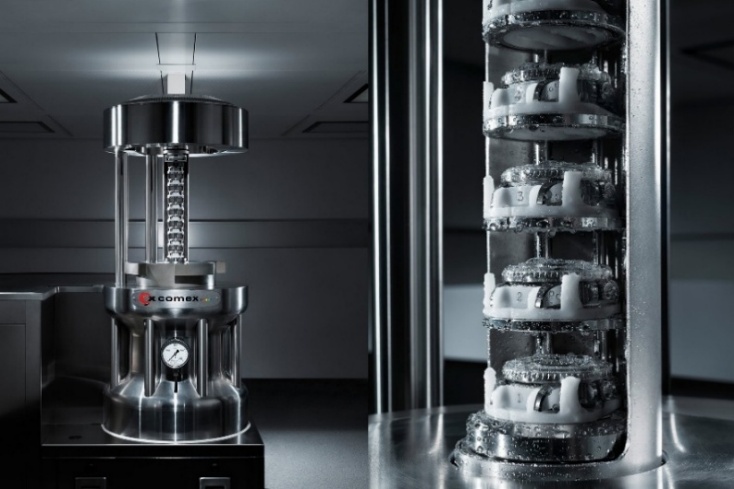
Credit of: Comex.fr
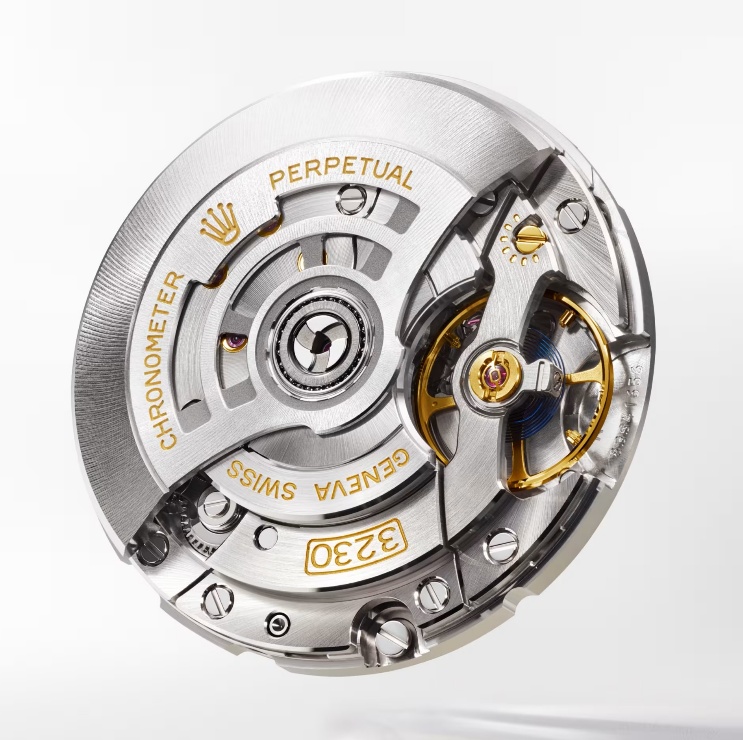
Beneath the domed sapphire crystal, a matte black dial of superb purity is revealed, where the absence of a date window creates a rare aesthetic symmetry. The large geometric hour markers and hands are crafted from 18K white gold and are entirely filled with the highly visible blue Chromalight luminescence, ensuring complete legibility in pitch darkness. Inside, the Rolex Manufacture Calibre 3230, a bidirectional self-winding mechanical movement with 31 jewels, beating at 28,800 vibrations/hour (4 Hz). Certified as a Superlative Chronometer, with a chronometric deviation of just -2/+2 seconds per day, this cutting-edge engine is equipped with the highly energy-efficient Chronergy escapement and the famous paramagnetic blue Parachrom hairspring, which provides a power reserve of approximately 70 hours and is up to 10 times more resistant to shocks than traditional hairsprings.


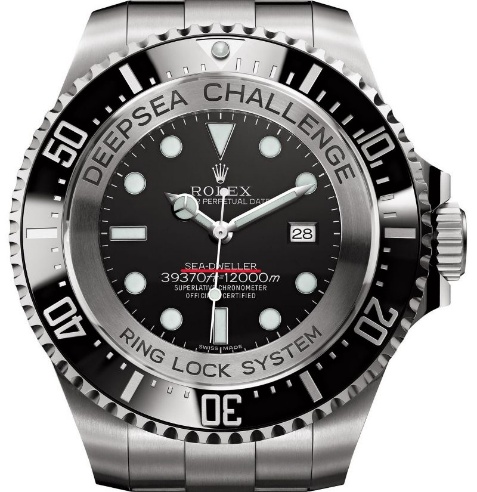
For the collector community, the sudden change in production of the Rolex Deepsea Challenge ref. 126067 was a bolt from the blue. Seeing the legendary "Sea-Dweller" lettering disappear from the dial, which inextricably linked it to the 2012 DEEPSEA CHALLENGE prototype, left purists deeply disappointed. That lettering wasn't just an aesthetic detail, but a fundamental historical thread, directly connecting this sacred monster of the seas to the glorious lineage born way back in 1967.

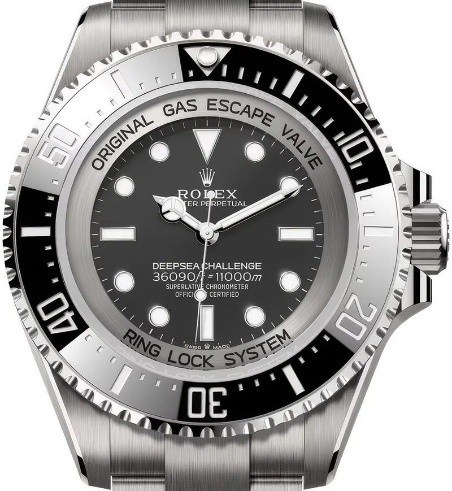
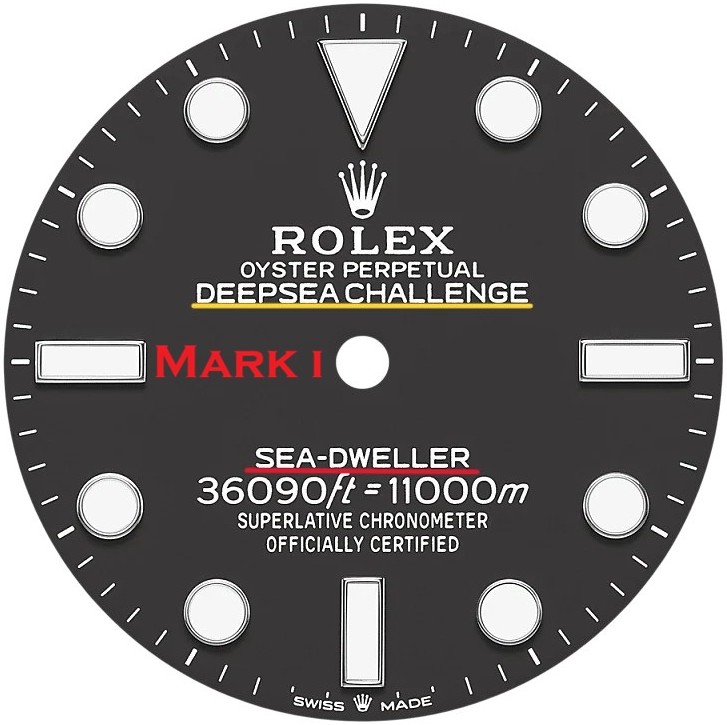
The benchmark for purists remains the Dial Mark I (2022 - 2024), the original launch configuration. This first model still proudly displayed the "Sea-Dweller" inscription, the ultimate tribute to the past dynasty. Unique in its kind, being the first of the series without a date display, the Mark I was christened by James Cameron and accompanied by a special commemorative box, which underlined its status as an extraordinary piece. With the arrival of the Dial Mark II (2025), Rolex instead imposed a drastic change of direction, which broke this emotional bond, the historic inscription being erased. This stylistic choice isolates the Deepsea Challenge on a totally independent path, giving it a clean dial, but depriving it of that historical reference, so dear to collectors. Since it is a silent evolution, never declared by the Swiss company, the transition between the two versions brings with it a fluid transition without clear boundaries, fueling the fascination and discussion around two quadrants born from the same project, but divided by a controversial choice.
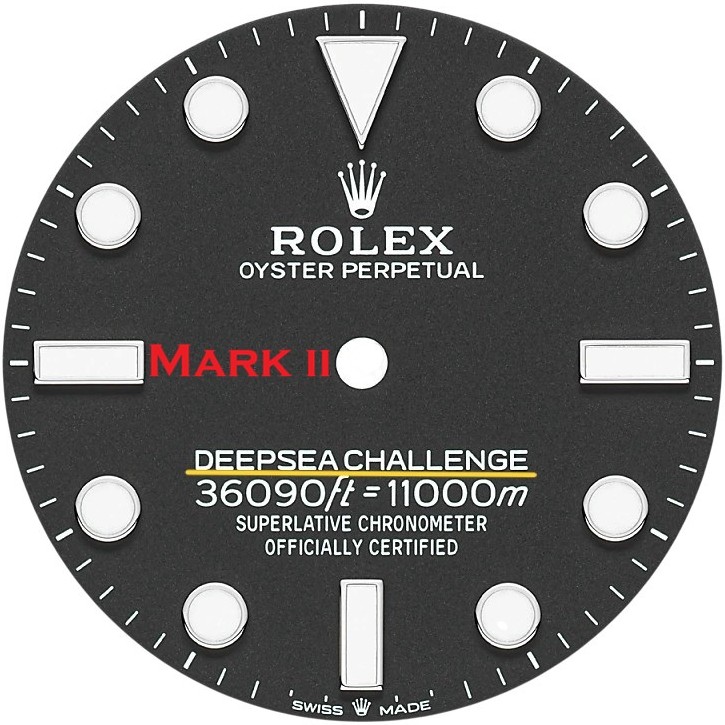
The Rolex Deepsea Challenge represents one of the brand's most fascinating chapters in contemporary production. This model, which carries the legacy of great experimental watches to the wrist, owes its allure to a select run of just 1,298 pieces. This fact was revealed by Nicholas Foulkes in his book Oyster Perpetual Submariner - The Watch That Unlocked the Deep, a volume that delves into the historic connection between the crowned brand and deep-sea exploration. Because of this limited production, availability of this reference is inevitably limited. Several official dealers around the world have never had the opportunity to receive a model to display or sell, making a live encounter with this timepiece a rare event for many in the industry. This already limited circle finds a further time limit in 2025, the year in which the introduction of the Mark II dial ended production of the first variant.

When analyzing a watch of this magnitude, technical considerations inevitably give way to pure collector's sensibility. The Deepsea Challenge stands as a monumental achievement in hyperbaric engineering applied to watchmaking, a masterpiece in which mechanics merge with the brand's extensive diving history. This timepiece is not for everyone. With its imposing 50 mm diameter, it demands a commanding wrist to be worn; yet, in the Rolex universe, dominated by visceral collecting, the choice is never a mere rational calculation, but rather an act guided by pure emotion.
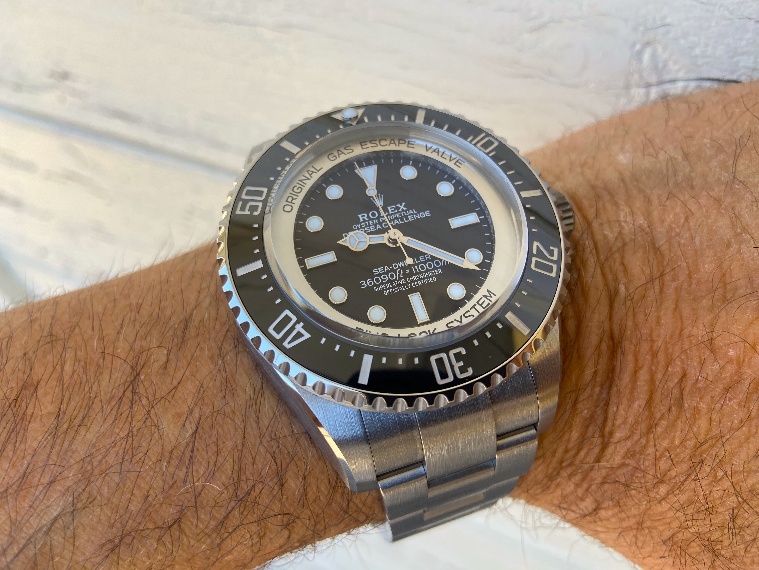
It is precisely in this sublime exception that cutting-edge technology, magnetic allure, and a burning desire to own it merge, elevating a simple precision instrument to a timeless cult object, a legendary status symbol destined to defy time. In this scenario, the first Mark I series, complete with its commemorative accessories and featuring the "Sea-Dweller" inscription, represents a historical chapter of extraordinary interest. The speed with which this first variant gave way to the Mark II version opens the door to fascinating hypotheses. With the fiftieth anniversary of the Rolex Sea-Dweller on the horizon in 2027, the scenario of possible commemorative novelties could herald the permanent deletion of the Deepsea Challenge Titanium from the price lists, a transition that would guide its inevitable rise on the secondary market. More than a simple manufactured object, this version remains a unique piece destined to stand the test of time, an instrument born to defy the depths, which has ultimately conquered collectors' eternity.


Chiedi a uno dei nostri esperti certificati una consulenza personalizzata.
Chiedi all'Esperto