Rolex Land-Dweller: Family DNA
It's spelled Land-Dweller, but it reads 'Future'. This is the latest gamble presented by Rolex in 2025; a timepiece that blends aesthetic genius and technical mastery, demonstrating how the brand can innovate by looking to its past. The DNA doesn't lie: the lines explicitly recall the historic family of Rolex watches with angular cases. However, to understand the essence of the Land-Dweller, one must delve into the lesser-known chapters of the manufacture. We must travel back in time, to the dark period of the 'Quartz Crisis' between the late 60s and early 70s. That storm brought Swiss watchmaking to its knees, but it also opened an era of absolute stylistic freedom and experimentation. In that moment of profound rupture, the watch ceased to be a simple instrument to become communication, leaving open the most unsettling question: was traditional mechanics truly destined to disappear?

The rise of quartz
In the 1960s, Swiss watchmaking had reached the pinnacle of technical excellence, creating mechanical movements of unparalleled precision and robustness. This supremacy, however, suddenly collapsed with the advent of quartz technology. These new watches, with their futuristic design, quickly conquered the market thanks to affordable prices, durability, and unprecedented accuracy. In a short time, the historic prestige of "Swiss Made" lost its value, and traditional models, began to be perceived as obsolete and too expensive. Consumer priorities shifted drastically from high craftsmanship to practicality, dealing a severe blow to the traditional Swiss industry.

Rolex's pioneering response
Rolex's ability to dominate the market comes from afar and, in particular, from the extraordinary vision of its founder Hans Wilsdorf. Already in 1952, years before the quartz boom, Wilsdorf intuited the potential of electric power and filed a first patent, although the technological limitations of the batteries of the time, hindered its commercialization. The push towards the future, continued in 1961 with the registration of the "Rolex Electrotime" trademark and adherence to the Swiss consortium CEH, which led to the launch of the Quartz 5100 in 1969. This propensity for risk and innovation, evidenced by over 600 patents, has never distorted the brand's classic identity, always based on precision, reliability, and the legendary obsession with water resistance. The real internal turning point occurred in 1971, when the Swiss house entrusted the difficult task of designing an entirely in-house quartz movement to the new Director of Research and Development, René Le Coultre: the caliber 5035. At the same time, to accommodate the trends of the moment and the rhythm of disco music, the brand revolutionized its traditional design. Classic curves, gave way to geometric lines and pronounced edges, introducing the famous integrated bracelets to the case. Although this new aesthetic was already ready in 1974, the gestation of the mechanical part took more time, thus leading to the official birth and registration of the Rolex Oysterquartz, trademark in September 1975.

Credit of: rolexmagazine.com
Oysterquartz: the perfect hybrid between tradition and revolution
It took five years of incessant innovation, starting from that idea in 1972, to achieve this result, but it was worth it, the Oysterquartz movement was a masterpiece that combined precision with the brand's distinctive resistance, a satisfaction that shone on René Le Coultre's face as he proudly presented it to the press. A horological triumph, not so much for the quartz technology itself, but for the way Rolex had interpreted it, maintaining its standards of excellence and robustness during the deep crisis of mechanical watchmaking. It's not a personal opinion, but history tells us, this watch testifies to how the brand responded to the quartz revolution by combining the reliability of electronics with the mastery of Swiss tradition. The movements, developed entirely in-house, are engineering peaks with excellent mechanical finishes: robust, precise and certified, so much so that they are still considered among the best calibers ever produced.

Credit of: rolexmagazine.com
1977 therefore marks the year in which Rolex officially presented the Datejust Oysterquartz line, with references 17000 in steel and 17013 in steel and gold; both powered by the brand new caliber 5035, the first quartz movement produced entirely in-house. Only the following year did the Day-Date Oysterquartz ref. 19018 appear, equipped with the COSC certified caliber 5055. Let's be clear: the Oysterquartz movements are "hybrids" based on the 3035 rather than true quartz movements, and although surpassed by more modern technologies, they remain among the most refined quartz calibers ever produced, still representing an absolute benchmark in their category today.

The credit for all this must be given to Rolex's stubbornness, determined to obtain a greater degree of precision than that of the previous caliber, therefore the oscillation frequency was increased by about 4 times compared to the Beta21. The 32,768 hz quartz crystal acts as a regulator to power an 11-jewel mechanism, exactly like that of a classic watch, while the temperature is constantly detected and processed by a chip that automatically regulates the oscillations of the quartz crystal. The annual error is less than a minute, but there is also a manual adjustment system for fine-tuning, even just to compensate for the natural aging of the quartz crystal over the years.

Credit of: watchclub.com
36mm angular case, smooth bezel and Oyster bracelet for the 17000, fluted bezel and similar-Jubilee bracelet for the 17013, they were extremely reliable, robust and precise chronometers, but in order not to further delay their introduction to the market, the first specimens were not sent to COSC for certification, thus not being able to immediately boast the words “Superlative Chronometer” printed on the dial, an aspect that would be resolved only in 1979 with subsequent specimens. Recognizing them at first glance will be very simple, just look at the writing printed at 6 o'clock, if in a single line, it will simply report the word OYSTERQUARTZ borrowed from the upper part under the crown, to compensate for the problem of the empty space that had been created due to the lack of COSC certification.

Credit of: watchclub.com
Oysterquartz Metamorphosis
Shortly after the Datejust Oysterquartz range expanded with the arrival of reference 17014, let's say a middle ground between the 17000 and the 17013, with a steel Jubilee-like bracelet and a fluted white gold bezel. Aesthetically perhaps the most successful and sexy of the three, but said with today's eyes and tastes, as at the time it was little requested, so much so that the Land-Dweller almost 50 years later largely takes up its aesthetics and colors, but obviously bringing with it 20th century technology and refinements, an extraordinary testimony to Rolex's ability to create pioneering designs simply drawing from its past.

Credit of: zeitauktion.com
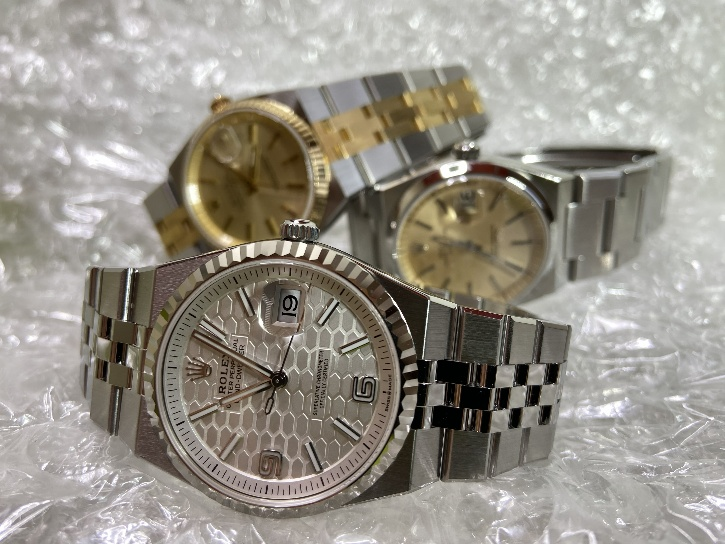
But while the Datejust Oysterquartz range expanded to only one additional model, the Day-Date Oysterquartz variants multiplied like mushrooms over the years, so alongside the two basic references 19018 in yellow gold and 19019 in white gold, 10 other very particular and rich versions of precious stones with bright colors were developed, most often at the specific request of customers. Some of them are extremely rare and expensive references, practically unique pieces worthy of a King, such as the 19078 Rainbow, the 19168 Octopus, or the spectacular ref. 19048 Honeycomb Pavé, which with its hexagonal dial, bridges the design of the classic guilloché dial and the modern honeycomb pattern of the Land-Dweller. 2001 will mark the final chapter of Rolex certifications for quartz movements, effectively marking the end of an era. In 2002, the steel Oysterquartz models disappeared from the catalogs, and in 2004 they definitively drew the curtain on the entire range, relegating them to the annals of watchmaking history.

Credit of: momentum-dubai.com
The quartz technology you don't expect from Rolex
Some might think that quartz was a failure for Rolex, but in reality, it's the opposite: a starting point, a prospective vision, a springboard for future technologies and innovations that it would incorporate into its timepieces. Yes, because while in the early 80s the Oysterquartz collection was populating with models, in 1987 Rolex filed a patent for a quartz perpetual calendar that could be adjusted via the winding crown. It is estimated that only 11 examples were made, prototypes assembled on a Datejust Oysterquartz 17014 case, both for the Day-Date version and for the Datejust. In 2020, one of these examples appeared at the Antiquorum auction, once again bringing to light the rumors that saw Rolex on the launch pad for a new objective, that of complications. Recently, however, Rolex is once again making headlines by filing a patent for an annual calendar, not a real revolution, but a redesigned evolution to make it more efficient and above all compact!

Courtesy Antiquorum
From the 1970 "Strange Couple" scandal to the New Land-Dweller
At this point, the family DNA clearly emerges: design and technological revolution merge, as in the best Rolex tradition. Some, however, will have noticed that I have not yet addressed the focal point. I intentionally kept it for last, so as to offer you a complete picture and avoid hasty conclusions. So let's take a step back. Let's go back to the early 70s to discover the true "parents" of the Rolex Land-Dweller. In 1971, René Le Coultre took over the leadership of the Research and Development sector. At that moment, the maison was eager to anticipate the times and launch that new geometric design that was now taking shape; something, however, did not go according to plan. Instead of witnessing the presentation of what only years later would become the Oysterquartz, Rolex surprised the market with reference 1630. This is an experimental two-tone Oyster Perpetual Datejust, a modern reinterpretation that combines tradition with the contemporary aesthetics of the time, but without any trace of quartz technology. Rolex itself confirms the date of 1974, officially publishing the photo of this reference on its website.

The brand, on the other hand, was almost forced to do so. It was necessary to explain to the public that the Land-Dweller did not come out of nowhere, but revives a stylistic language that has belonged to the brand for over fifty years. It is a story that found fertile ground in the Oysterquartz, and which today writes a new, higher-level chapter: the future of Rolex is rooted in its past, because innovating does not always mean starting from scratch, but reinventing what is already history. On its website, the maison rightly highlighted the 1630, the "mother" of the Land-Dweller, as the aesthetic resemblance is truly remarkable. Being a Datejust, it immediately conveys a high-end perception; much like in car advertisements, where the most accessorized model is shown and never the basic one. In this case, the "basic version" is the steel Oyster Perpetual Date, reference 1530: the true "father" of the Land-Dweller. According to my research on case serial numbers, the 1530 was made and assembled before the 1630, yet Rolex, at least for now, does not mention it on its portal, strange isn't it?

The reality is that there were two prototypes that anticipated the Oysterquartz era by three years: the steel Date 1530, and the steel and gold Datejust 1630. If we exclude the bezels and different bracelets, the two watches are practically identical, both with a 36mm case. Rolex, however, made an unusual choice, using a 34mm Oysterdate dial for the 1530, and a Datejust dial for the 1630; who knows why. Despite the aesthetics anticipating the Oysterquartz, both models are powered by the automatic caliber 1570; this movement, having different dimensions compared to the quartz caliber 5035, forced Rolex to insert an inclined rehaut on the dial to compensate for the thickness. The result? A "recessed" looking dial, a unique three-dimensionality, that resembled no other crown design. This, at least, until 2025: the new Land-Dweller, now exactly replicates that particular detail.

Very little information has circulated about these models, partly because production was limited. The first-series Date 1530, with its dedicated reference 96660 bracelet, earned the nickname ‘The rare bird’. The 1630 appears a little more often, although it is hardly a common sight. Several explanations have been proposed for their introduction. Some accounts describe them as a way of testing reactions to the new design in selected markets, including North America and Japan. Another frequently cited explanation is that the Oysterquartz-style cases and bracelets were ready before calibre 5035 could enter commercial production. Fitting an automatic movement would have allowed Rolex to introduce the new appearance sooner. These remain interpretations of the history rather than a reason to assume that every detail of their development is documented.

Whatever the original motivation, these watches are among the least conventional Rolex designs, yet also illustrate the brand's willingness to experiment. Half a century later, the unusual pairing of the 1530 and 1630 finds a visual successor in the Land-Dweller. Look closely at the relationship: the modern watch recalls elements of both while retaining an identity of its own. The family resemblance is difficult to miss.

A new Rolex platform combining design and technical development
The Land-Dweller deserves a closer look. Its angular forms recall the 1970s Oysterquartz family, while its mechanical architecture takes the story in a new direction. This is more than a change of dial or bezel: the collection brings a different combination of case, bracelet and movement to the Rolex range, connecting familiar design cues with modern engineering.

At launch, the family offered three material options: white Rolesor, the version examined here, Everose gold and platinum, each in 36 mm and 40 mm sizes. The combination joins clean case lines and an integrated bracelet with a newly developed movement. It gives the collection a distinct position within the Rolex catalogue.

I see the Land-Dweller as a possible platform for future development. An expansion into complications, perhaps even a perpetual calendar, is an intriguing possibility, but it is my speculation, not an announced Rolex product. A simpler version is another conceivable direction: a smooth bezel, a different bracelet or a closed caseback could produce a very different character. The history of the 1530 and 1630 shows how closely related forms can carry different identities. Whether Rolex chooses either path remains unknown.

The Land-Dweller's design combines a contemporary silhouette with clear references to the past. Different finishes catch the light across the case, bezel and bracelet, giving the watch a strong visual identity. Its geometry departs from the rounded forms that many people associate with Rolex. That makes it a divisive design, but also one with a recognisable character of its own.


The first detail that draws my attention is the dial. Beyond its colour and the numerals at 6 and 9, the honeycomb pattern creates an unusual texture. Laser work helps define the motif and its fine details. Earlier patterned Datejust dials provide an interesting point of comparison, although the Land-Dweller develops a different visual effect.

Viewed straight on, the intense white dial has a restrained, almost satin appearance. At other angles it becomes more dynamic, with shifting impressions of cream and pearly grey. The honeycomb cells, the thin case and the inclined rehaut work together to emphasise depth and direct attention towards the centre. This description reflects how the watch appears under changing light rather than a change in the dial's actual colour.


But if side A captivates you with its intoxicating nuances, side B is no less, it suddenly shakes you as soon as you realize that instead of the classic steel case back, a sapphire crystal finds its place, showcasing the intimacy of the Land- Dweller , its revolutionary movement . A caliber designed and manufactured with the precise aim of redefining the concepts of efficiency and reliability in luxury watchmaking, in order to guarantee in the long term the best possible performance , with servicing requirements that should be checked against the manufacturer’s guidance. More simply, without beating around the bush: Rolex has made possible, and thus industrialized, what until a few years ago seemed almost impossible ! This is the 7135, a 5 Hz caliber ( 36,000 vibrations per hour ) equipped with silicon components that make it almost insensitive to magnetic fields , with a new architecture and the patented Dynapulse escapement , which allows the alignment of components on the same plane, reducing internal friction and improving energy efficiency , a true renewal in the world of watchmaking.

The Flat Jubilee bracelet is central to the effect. Inspired by the five-link Jubilee design, it alternates polished and satin-finished surfaces and meets the case in a continuous line. A concealed clasp leaves the small Rolex crown as the visible closing detail. Chamfers and tightly fitted components contribute both to the appearance and to comfort. For me, one compromise is the lack of an on-the-fly micro-adjustment: achieving the right fit relies on bracelet sizing. It is a practical consideration worth checking on the wrist before deciding.

The family resemblance behind the new Rolex collection
With the Land-Dweller, Rolex has introduced more than another variation on an established model. The collection offers a different way to combine the brand's history with its current engineering. I have often described the Oysterquartz as a watch whose appeal is not universal. The Land-Dweller takes that visual heritage in a new direction, with materials and sizes that may interest a broader range of enthusiasts.

The choice of 36 mm and 40 mm cases makes trying both sizes worthwhile. Practicality, elegance and personal fit will matter as much as technical specifications. For collectors drawn to the relationship between older Rolex designs and contemporary watchmaking, the Land-Dweller offers a compelling subject: a new watch connected to its predecessors by a recognisable family DNA.




Chiedi a uno dei nostri esperti certificati una consulenza personalizzata.
Chiedi all'Esperto